Bicycle accidents are a common problem. We have handled plenty of cases involving bicycles hit by cars, other bikes, pedestrians, and even a lawn mower. Our focus in these cases is to preserve the evidence, nail down the theory of liability, and make sure the injured person gets the medical care they need. Then our focus changes to getting the most money that we ethically can on behalf of the injured client. Please give us a call at (215) 997-1000 for a free strategy session to see what we can do for you – whether you are looking to settle out of court or go to trial.
Here at Fairlie & Lippy, P.C., we have experience with the risk factors of riding bicycles, on the road and offroad, the body mechanics of how injuries happen, the unique characteristics and laws surrounding the usage of bicycles, and the best way to pursue and recover everything you’re entitled to. We have even handled cases involving e-bikes and the special regulations that cover their usage.
Rules of the Road for Bicycle Accidents
Bicycle riders have to obey the same traffic laws that motor vehicles do. Of course, there are situations where it’s impossible for a bicycle to act just like a car, and there’s a section of the Pennsylvania Vehicle Code that has specific rules for bicycles. Bicycles are called “pedalcycles” in the Vehicle Code.
If you’re ever involved in a bicycle accident, the other driver’s insurance company and legal team are going to carefully look into whether you were breaking any general traffic laws or any bicycle traffic laws. If they can prove that you probably violated any of these laws, your ability to recover damages might be significantly reduced or even eliminated. Aside from your own safety, this is why it’s crucial to make sure you carefully obey all traffic laws when riding a bike.
Here are some of the traffic laws that specifically govern bicycles:
One Person Per Seat
You’re not allowed to ride a bike that doesn’t have a “permanent and regular” seat attached to it. One seat is required per rider. So, if you don’t have two permanent seats, you can’t have somebody ride with you on your bike. The only exception is for a secure child carrier. Even though it’s not “permanent,” you can use one of these seats to transport a child.
Bicycle Accidents on the Roadways and on Bike Paths
When riding on a public road bike riders have to obey the rest of the rules of the road unless there’s an exception for bikes. Bicycles, unlike cars, can be operated on the shoulder of the road.
In most suburban or rural areas, bicycle traffic is going to be slower than motor vehicle traffic. When that’s the case, the bicyclist can actually ride down the middle of the travel lane if the road only has one lane in each direction. If it’s two lanes or more in any direction, the bicycle must stay in the right lane. Where the road has no lane markings, the bike must stay as close to the right-hand edge of the road as possible. If the road is a one-way, you can ride your bike as close to the left edge of the road as possible.
Even if you take your bicycle on a two-lane road that has one lane in each direction, is marked with double-yellow lines, and has a “NO PASSING ZONE” sign, don’t expect that the traffic behind you will stay behind you. There’s a specific part of the Vehicle Code that says the No-Passing Zone laws don’t apply when passing a pedalcycle. The vehicle driver just has to leave at least 4 feet of clearance and has to pass at a “careful and prudent reduced speed.“
Unless you’re on a bike path or in a designated bike lane, you can’t ride side-by-side with more than one other bike. In other words, when on the road, bicycles can only ride in a horizontal line two bikes wide.
Bicycle Accidents while Carrying Items
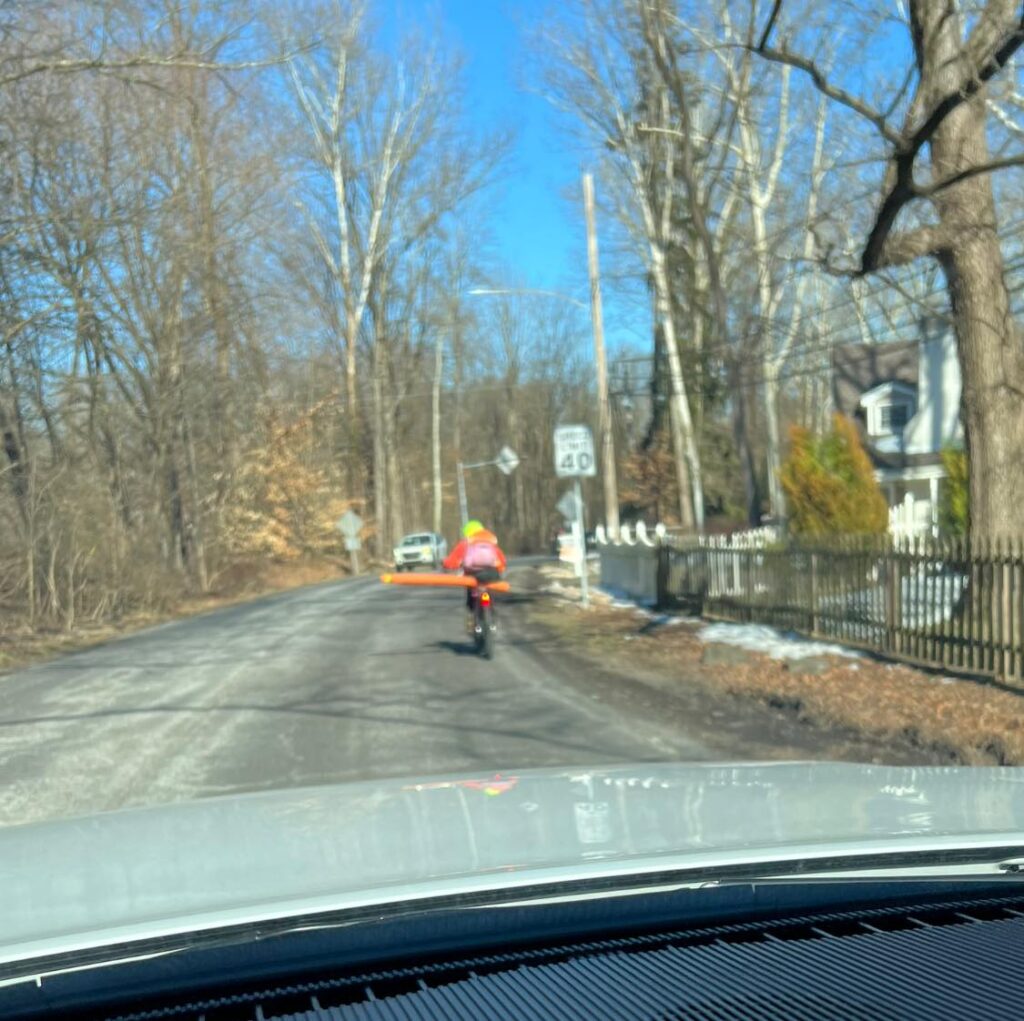
You can hold or carry things while riding a bicycle as long as they don’t prevent you from keeping at least one hand on the handlebars. On one hand, it might be pretty impressive if somebody could carry bags of groceries in both hands while biking home without ever touching the handlebars. But on the other hand, common sense tells us that that’s a really dangerous idea.
Headlights & Reflectors
If you’re going to ride a bicycle between sunset and sunrise, you need to have lights and reflectors.
- Headlights: The bike has to have a white headlight visible at least 500 feet away.
- Rear Reflector: The bike must have a rear-facing red reflector visible from at least 500 feet away. While only a reflector and not a light is required for the rear, a light is obviously the better and more visible device.
- Side Reflector: The bike must have an amber-colored reflector on each side. The easiest way to accomplish this is by attaching a double-sided amber reflector to the spokes of each wheel.
Brakes
Check your brakes regularly! Brakes are the most important pieces of equipment when it comes to keeping you safe. Under the law, your bike’s brakes have to bring the bike to a stop within 15 feet at a speed of 15 MPH on a dry, flat surface. Since most of us don’t have a radar gun at home to measure our speed, 15 MPH is faster than a casual stroll but slower than race speeds. You don’t have to equip your bike with a brake-light system.
Sidewalks and Pedestrians in Bicycle Accidents
Riding on a sidewalk is something you can do with a bicycle but certainly not with a car. There’s an exception for “business districts”; you can only ride on the sidewalk there if signs allow it. When you do decide to ride on the sidewalk, or on a bike path that pedestrians also use, the pedestrians get the right-of-way. A bicycle collision with a pedestrian can result in serious injuries for both people. A bike rider can pass a pedestrian, but only after giving an audible warning beforehand. If you’ve ever been walking and heard something from behind like “on your left!”, that’s an “audible signal” that you’re about to get passed by a bike.
Bicycles on Expressways – PROHIBITED
For obvious safety reasons, nobody is allowed to ride a bicycle on a freeway or expressway. While the law provides for exceptions to be made for ceremonies and fundraisers like the Ben to the Shore Bike Tour, or for people who literally have no other way to get around, this law is pretty clear and commonsense.
Helmets Required for Kids under 12
Everybody, no matter how young or old or how new or experienced, should wear a helmet while riding a bicycle in any location. Pennsylvania law requires that any child under 12 years old must wear a helmet while riding a bike. It also applies to any child riding in a trailer or in an attached child seat.
The parent(s) or legal guardian(s) of the child can get a citation for this offense, too. Just another reason to make sure your child understands the importance of properly wearing a helmet and never taking it off until finished riding! Luckily, the law provides a way out; if you show proof to the judge at or before the hearing that you’ve bought a helmet in the meantime, the judge is required to throw the case out.
While it’s of utmost importance to make sure kids always wear their helmets and avoid a serious head injury, the law is somewhat forgiving in the event of a tragedy. If a child is struck while riding a bike, and wasn’t wearing his or her helmet, the defendant is prohibited from using the lack of helmet as evidence against the child, or to somehow place blame on the child or child’s parents.
Bicycles with Electric Assist
We see electric-powered bicycles more and more these days. Since they have the ability to travel at faster speeds for longer periods of time, a person has to be at least 16 years old to drive one.
Contact Us for your Bicycle Accident Case
When figuring out how to recover damages after a bicycle accident, it’s imperative to understand the physics of what led up to it and the medical details of short-term and long-term effects of the injuries. It is equally crucial to be mindful of the elements that are unique to a bicycle accident, as opposed to accidents in general. By focusing on these important details, we can reconstruct the contributing factors of the bicycle accident, fully keep track of all injuries, and craft an accurate and thorough claim. You also need an attorney who is familiar with Pennsylvania Bicycle Laws – not someone who will have to reinvent the wheel.
At Fairlie & Lippy, P.C., we have the experience and knowledge to find, focus on, and present all the evidence that will result in the best possible recovery. Call us at (215) 997-1000 if you have been involved in a bicycle accident.